Diplomacy with Aliens: The Story of the Voyager Golden Records
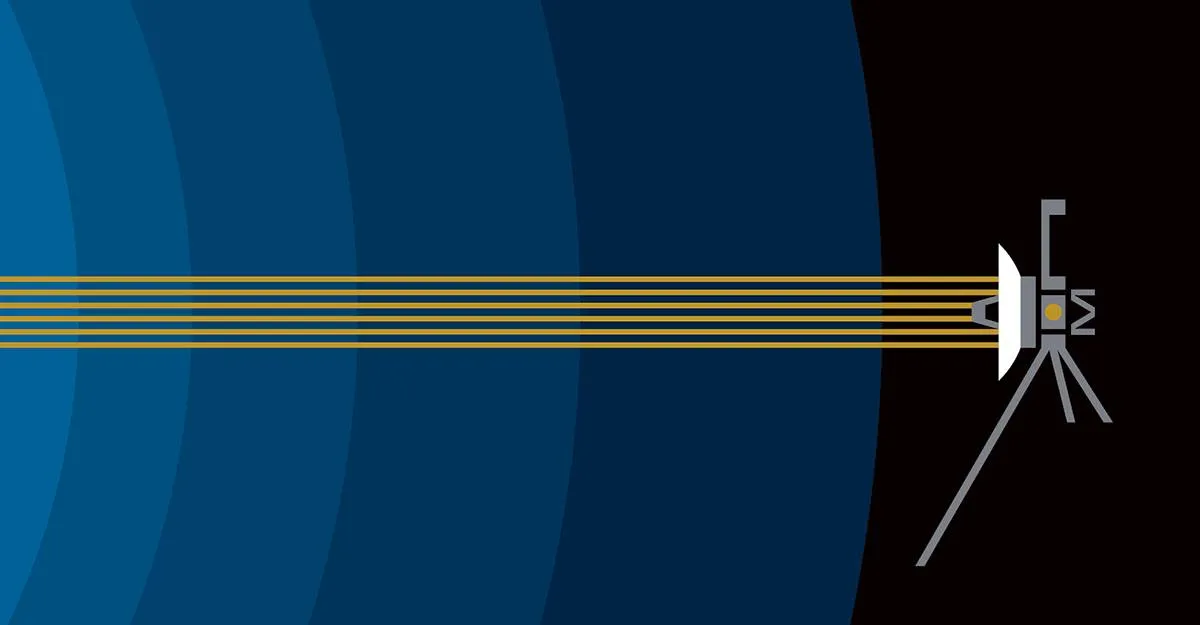
This post was adapted from a project for my Honors World History class during my junior year of high school.
07:56 AM, September 5, 1977. Shortly before Voyager 1’s launch, a few strips of aluminum foil were just added for extra radiation shielding – the same stuff you’d use in your kitchen. But on that date, history was being made. The first probe to cross into interstellar space was launched, and humans might not be the only ones that know about it. Attached to the probe is a twelve-inch gold-plated copper disk with information about Earth. Its audience wasn’t for any of us, but rather for intelligent life on other planets. But to truly understand the Voyager Golden Records, we first need to take a look at our previous attempts to communicate with other beings.
During the climax of the Space Race, Apollo 11 left both a commemorative plaque and a disk on the moon. The disk contained microscopic text from many world leaders, at least those that were allied with the United States at the time. However, these objects were not very concerned with communicating any meaningful information to anyone that is unable to understand any Earthly languages. This made it much more of a political symbol than anything that beings from another world would find useful.
It wasn’t until the Pioneer 10 and 11 probes that the focus would shift to communication that didn’t hinge on the understanding of languages found on Earth. Two professors of astronomy, Dr. Carl Sagan and Dr. Frank Drake, were excited by the opportunity that these probes could one day leave our solar system and serve as a means to communicate with intelligent life somewhere else in the universe. In a report to NASA, they wrote that the Pioneer Spacecraft should “carry some indication of the locale, epoch and nature of its builders” as a “hopeful symbol of a vigorous civilization on Earth” (Sagan et al. 2, 5).
The Pioneer Probes contained a plaque containing several pieces of information and diagrams these astronomers thought were key to understanding the probe and its origins if intelligent life was to find it. One of these diagrams was a picture of a naked man and woman, which faced many controversies. Of course to other beings, the idea of clothing may be completely foreign, but the fact that a government agency was installing pictures of genitalia on their space probes certainly upset some at the time. In a letter to the editor of the Los Angeles Times by Allan McCollum, he compared this to the “bombardment of pornography through the media of film and smut magazines” and noted that our “space agency officials have found it necessary to spread this filth even beyond our own solar system” (Sagan 25).
Voyager 1 and 2 were both launched during the tail end of the Space Race, with much enthusiasm about space exploration still existing in the public consciousness. The probes were launched within a few weeks of each other. They both took advantage of the rare planetary alignment of Jupiter, Saturn, Uranus, and Neptune that allowed them to slingshot their way farther away from earth. By falling into the strong gravitational field of these gas giants, they could travel deep into the solar system with a low amount of fuel. Alignments like these only happen once every 175 years. Each probe had attached to it a 12-inch gold-plated copper disk that included images, music, sounds, and greetings.
However, the challenge arises with how to encode this information on the record, and furthermore how to communicate instructions of how to decode the information. It’s not like the information could be written in English, or any other language that is spoken on Earth for that matter. The other forms of intelligent life that Sagan and Drake were targeting may not even experience the same five senses of sight, smell, sound, taste, and touch that we humans do. Rather, these instructions were written in the universal languages of the universe: math and science. While explaining the exact process may come across as verbose, a quick overview of the record’s cover aids in the understanding of interplanetary communication.
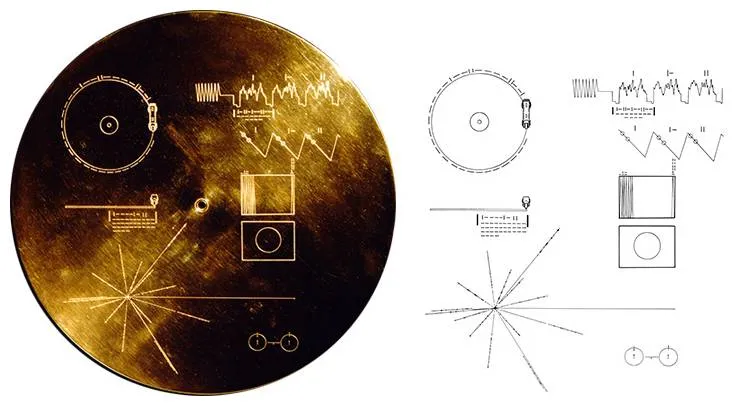
On the bottom right, a diagram of a hydrogen atom is shown. The transition time between two states of this atom is the unit of time used across the rest of the record and the pictures encoded on it. It was assumed that other forms of intelligent life would know the timing of this transition since it is a universal constant. The bottom left shows a diagram of several pulsar stars near our planet with their frequency shown along their path in binary code. It was hoped that the location of these stars could help triangulate the location of our solar system and where we live. However, it’s a different question altogether if we want intelligent life to know our location, as they could possibly have malicious intentions. The top left includes diagrams of the record itself from a top and side view, depicting the proper speed to turn the record and the playing time of the record. On the top right, there are multiple diagrams about decoding the video portion of the record, including the waveform of the video signal, the time of the scan, when to trigger the scan, the direction of the scan, and how many scan-sweeps to form a picture. Below that is a picture of a circle, which is the first image that will appear if the video is properly decoded.
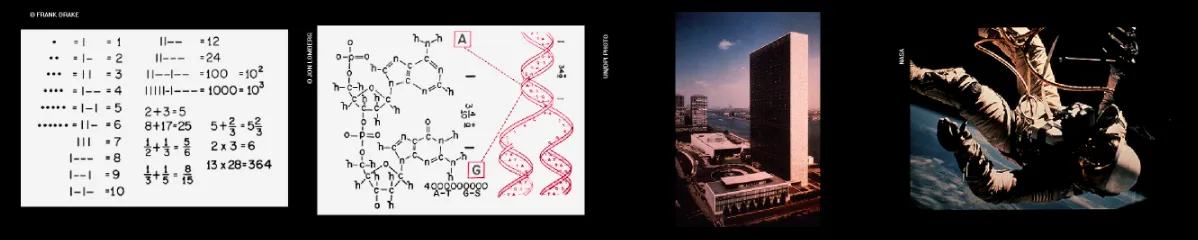
The content encoded on the record contained much more information than anything that could have been inscribed onto the cover of the record. There were more than 115 images, including mathematical and physical unit definitions, several diagrams of chemicals, DNA structure, the process of conception, continental drift, pictures of houses and skyscrapers across many cultures, music, rockets, astronauts, and the Arecibo Radio Telescope. Several music selections were included on the record from both Eastern and Western cultures, in addition to a variety of natural sounds. The record also contained greetings in 55 different languages from across the world. President Jimmy Carter and U.N. Secretary General Waldheim also had messages that were included on the record.
There’s no doubt that the Voyager Probes had a tremendous impact on the scientific community. The information that they have gathered (and will continue to gather) was essential to our understanding of the planets in our solar system. While only four out of the original eleven scientific instruments are still active on Voyager 1, it is expected that we’ll still be able to contact the probe for a few more years until it runs out of power (Nevres). However, the legacy of the Voyager Golden Records is a bit more complicated.
The likelihood that either of the Voyager Probes will come in contact with any other forms of intelligent life is slim, to say the least. It will take Voyager 1 around 40,000 years to come within 1.6 light-years to the star AC +79 3888. Even if there was intelligent life that found the probe, it would take so long that anything found on the Golden Record would not be an accurate depiction of the state of humanity – if humanity will even exist in 40,000 years. As Canadian commentator J.J. McCullough puts it, “on some level, none of this stuff has ever really been about the aliens. It’s always been about us”.
Rather, it serves as a beacon of hope, sent out to the Universe. Hope that our day-to-day lives mean something in the grand scheme of things. Hope that we have made a legacy for ourselves. Hope that there won’t be a day where humanity is forgotten by the cosmos. It’s fun to dream about life from far away encountering a time capsule all about us, but in reality, the Voyager Golden Records tell us much more about ourselves than anything else.
Works Cited
“Apollo 11 Plaque.” NASA Science: Earth’s Moon, NASA, 20 Oct. 2017, https://moon.nasa.gov/resources/136/apollo-11-plaque/.
Gambino, Megan. “What Is on Voyager’s Golden Record?” Smithsonian Magazine, 22 Apr. 2012, https://www.smithsonianmag.com/science-nature/what-is-on-voyagers-golden-record-73063839.
“The Golden Record.” Jet Propulsion Laboratory, NASA, https://voyager.jpl.nasa.gov/golden-record/.
Greicius, Tony. “NASA Spacecraft Embarks on Historic Journey Into Interstellar Space.” NASA, 12 Sept. 2012, https://www.nasa.gov/mission_pages/voyager/voyager20130912.html.
McCullough, J.J. “Our failed attempts to teach aliens about Earth.” YouTube, 15 Jan. 2022, https://youtube.com/watch?v=M4A2SXGTiso.
“Messages to and from Outer Space.” Library of Congress, United States Government, https://www.loc.gov/collections/finding-our-place-in-the-cosmos-with-carl-sagan/articles-and-essays/life-on-other-worlds/messages-to-and-from-outer-space/.
NASA Jet Propulsion Laboratory. Voyager Golden Record Cover Explanation. Wikimedia Foundation, https://commons.wikimedia.org/w/index.php?title=File:Voyager_Golden_Record_Cover_Explanation.svg.
Nevres, Özgür. “How far can Voyager 1 go before we lose contact?” Our Planet, 10 Jan. 2019, https://ourplnt.com/voyager-1-lose-contact/.
Pearlman, Robert Z. “The Untold Story: How One Small Disc Carried One Giant Message for Mankind.” Space, Future US, 16 Nov. 2007, https://www.space.com/4655-untold-story-small-disc-carried-giant-message-mankind.html.
“Pioneer Plaque.” NASA Science: Solar System Exploration, NASA, 13 Feb. 2018, https://solarsystem.nasa.gov/resources/706/pioneer-plaque/.
Sagan, Carl. Carl Sagan’s Cosmic Connection: An Extraterrestrial Perspective. Edited by Jerome Agel, Cambridge UP, 2000.
Sagan, Carl, et al. “A Message from Earth.” Science, vol. 175, no. 4024, 1972, pp. 881-84. JSTOR, https://www.jstor.org/stable/1733664.
Zapatka, Cory. “Decoding Images from the Golden Record.” The Verge, Vox Media, 30 Oct. 2018, https://www.theverge.com/2018/10/30/18037984/golden-record-nasa-image-decode-voyager-1-2.
